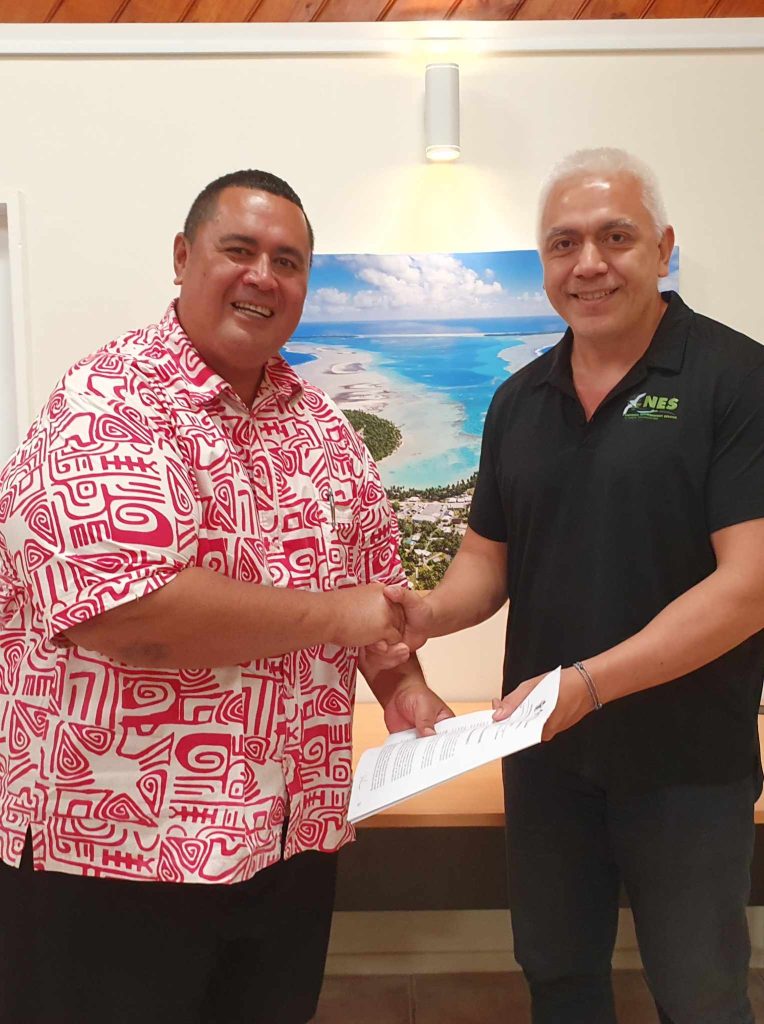


Negotiators from the fourteen Pacific states met in Apia in early July 2025, to discuss preparations for the upcoming fifth session for an international legally binding instrument to end plastic pollution, or known as INC5.2, which will be held in Geneva from 5 to 14 August 2025. NES Director, Halatoa Fua, and NES Manager of Environmental Policy and Planning, Tekura Moeka’a, represented the Cook Islands at this preparatory meeting.
The first day of the meeting was spent on gathering outcomes from various meetings recently held by the Heads of Delegation (HOD), Asia Pacific Group (APG), and the Alliance of Small Islands Developing States (AOSIS). These meetings reaffirmed that while majority of parties want to address a full-life cycle approach on plastic pollution to include production and chemicals of concern, a handful of countries still see the scope of the treaty being focused on waste management only. In the afternoon, the Pacific negotiators held bilateral roundtable discussions with New Zealand and Australia on various articles relating to production, plastic products, plastic design and the financial mechanism. The roundtable was useful in building a common understanding with New Zealand and Australia, who also represent the views of developed countries.
The negotiators used the second day as an opportunity to deep dive into the text of each article, discuss regional positions and new bridging proposals made by various countries at the HOD. Some of the key takeaways from these discussions is the solidarity amongst Pacific countries to continue negotiating for an ambitious and effective treaty, including accessible finance, capacity building, and incorporating the full lifecycle of plastics e.g. including provisions on production, chemicals of concern, and an initial list of products and chemicals of concern.
The final day of the preparatory meeting was focused on discussing a strategy on procedural and substantive discussions, participation of ministers at the negotiations, and coordination plans for the Pacific delegates while in Geneva. Further work is required to build on a clear strategy for the Pacific negotiators, which will be discussed further at the Pacific coordination meeting on 1August, ahead of the INC5.2 negotiation sessions.
In a timely development, the recent advisory opinion delivered by the International Court of Justice (ICJ) affirms the legal responsibilities of states to prevent environmental harm that contributes to climate change. This strengthens the case for global obligations to curb plastic production and emissions, as plastics contribute significantly to greenhouse gas emissions across their life cycle—from fossil fuel extraction to end-of-life incineration or degradation. The ICJ outcome supports the argument that failure to act on plastic pollution is not just an environmental issue but also a breach of states’ duties under international law. As such, addressing plastic pollution through a full life-cycle approach, including upstream measures, is not only necessary for ocean health but also essential for climate integrity.
Negotiators are anticipating difficult discussions in Geneva to reach an agreement that is effective and takes into account the special circumstances of small islands developing states like the Cook Islands. While plastic pollution is expected to nearly double by 2040 based on a ‘business as usual’ scenario, large plastic producing countries are avoiding obligations that may restrain production or chemicals of concern that is threatening human health and the environment. The Cook Islands stand united with a group of 97 countries that endorsed the Nice Wake Up Call. It is a call to ensure an effective treaty is adopted to address the plastic pollution crisis that is polluting our oceans, waterways, and lands.